Biography
E-Mail: natadiaz@uchile.cl
Dr. Natalia Díaz-Valdivia is a Biochemist from the Pontificia Universidad Católica de Valparaíso (2010) and holds a PhD in Biochemistry from the University of Chile (2016). She is currently an Assistant Professor and Principal Investigator at the Interdisciplinary Nucleus of Biology and Genetics (NiBG), Institute of Biomedical Sciences (ICBM), Faculty of Medicine, University of Chile.
Dr. Díaz-Valdivia has extensive experience in basic and translational cancer research, focusing on the molecular mechanisms underlying tumor progression, metastasis, angiogenesis, and therapeutic resistance. Her scientific career began at the Cellular Communications Laboratory, under the supervision of Drs. Andrew Quest and Lisette Leyton, where she investigated the role of caveolin-1 in cancer cell migration, invasion, and metastasis. Her doctoral and subsequent postdoctoral research contributed to understanding how caveolin-1 phosphorylation regulates mitochondrial dysfunction and metabolic reprogramming, and identified the tyrosine phosphatase PTPN14 as a negative regulator of caveolin-1-mediated metastasis.
In 2018, she joined the University of Barcelona (Spain) as a postdoctoral researcher in Dr. Jordi Alcaraz’s group, supported by Becas Chile fellowship. During this period, she specialized in the study of the lung cancer tumor microenvironment, particularly the role of tumor-associated fibroblasts (TAFs/CAFs) in tumor angiogenesis and resistance to antiangiogenic therapies. Her research contributed to identifying histotype-specific differences in stromal regulation of angiogenesis, highlighting the involvement of TIMP-1, VEGF-A, and SMAD2/3 signaling in lung adenocarcinoma and squamous cell carcinoma.
More recently, she joined the Institute for Research in Biomedicine (IRB Barcelona), where she investigated the crosstalk between MAPK signaling pathways (ERK, p38, and JNK) and their role in cellular homeostasis and adaptation to stress, with a particular focus on PAK1-dependent regulatory mechanisms.
In October 2026, Dr. Díaz-Valdivia returned to the University of Chile as an Assistant Professor, establishing an independent research line focused on understanding how the tumor microenvironment contributes to therapeutic resistance in lung cancer. Her current research investigates the molecular mechanisms through which tumor-associated fibroblasts promote angiogenesis and resistance to antiangiogenic therapies, particularly through ERK/CXCL-1/CXCR2 signaling. By integrating molecular and cellular approaches with preclinical and patient-derived tumor models, her work aims to identify novel therapeutic strategies to overcome stromal-mediated resistance and improve treatment responses.
Throughout her career, Dr. Díaz-Valdivia has participated in national and international collaborative research projects, including the European Union Horizon 2020 STRETCHbio project. She has authored 32 peer-reviewed scientific publications, including five as first author, and has an h-index of 18 (Web of Science). She has also contributed to undergraduate teaching and the training of young researchers in Chile and Spain.
Current Research
Tumor Microenvironment, Angiogenesis, and Therapeutic Resistance in Lung Cancer
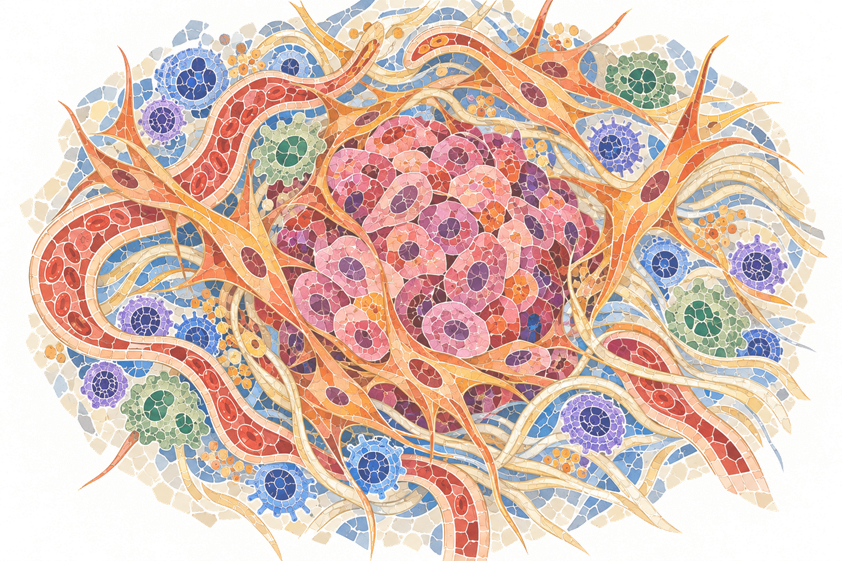
Dr. Díaz-Valdivia’s research focuses on understanding the molecular and cellular mechanisms by which tumor-associated fibroblasts regulate angiogenesis and contribute to resistance to antiangiogenic therapies in non-small cell lung cancer.
Her current work investigates how differences in stromal signaling between lung adenocarcinoma (LUAD) and lung squamous cell carcinoma (LUSC) influence therapeutic responses, with particular emphasis on the ERK/CXCL-1/CXCR2 signaling axis. By combining molecular and cellular approaches with three-dimensional angiogenesis assays, preclinical models, and patient-derived tumor samples, her research seeks to identify mechanisms of stromal-mediated therapeutic resistance.
The ultimate goal is to identify stromal vulnerabilities and develop combination therapeutic strategies capable of overcoming resistance to antiangiogenic treatments and improving therapeutic responses in lung cancer.
Selected Publications
- Díaz-Valdivia, N., Duch, P., Ikemori, R., Arshakyan, M., Parker, A. L., Llorente, A., Bernardo, A., Park, D., Sahai, E., Fillat, C., Juan, M., Nadal, E., Reguart, N., Radisky, D., Casanovas, O., Alcaraz, J. (2026). Antagonistic SMAD2/3 control of TIMP-1, VEGF-A, and hypoxia signaling in myofibroblasts shapes histotype-specific angiogenesis in lung cancer. Cell Death & Disease. DOI
- Bernardo, A., Díaz-Valdivia, N., Fernández-Nogueira, P., Alcaraz, J. (2025). Stromagenesis and cancer-associated fibroblast heterogeneity in primary tumors and metastasis: focus in non-small cell lung cancer. FEBS Open Bio. DOI
- Duch, P., Díaz-Valdivia, N., Gabasa, M., Ikemori, R., Arshakyan, M., Fernández-Nogueira, P., Llorente, A., Teixidó, C., Ramírez, J., Pereda, J., Chuliá-Peris, L., Galbis, J. M., Hilberg, F., Reguart, N., Radisky, D., Alcaraz, J. (2024). Aberrant TIMP-1 production in tumor-associated fibroblasts drives the selective benefits of nintedanib in lung adenocarcinoma. Cancer Science. DOI
- Simón, L., Torres, K., Contreras, P., Díaz-Valdivia, N., Leyton, L., Quest, A. F. G. (2024). Inhibition of glycolysis and Src/Akt signaling reduces Caveolin-1-enhanced metastasis. Biomedicine & Pharmacotherapy. DOI
- Juste-Lanas, Y., Díaz-Valdivia, N., Llorente, A., Ikemori, R., Bernardo, A., Arshakyan, M., Borau, C., Ramírez, J., Ruffinelli, C., Nadal, E., Reguart, N., García-Aznar, J. M., Alcaraz, J. (2023). 3D collagen migration patterns reveal a SMAD3-dependent and TGF-β1-independent mechanism of recruitment for tumor associated fibroblasts in lung adenocarcinoma. British Journal of Cancer, 128, 967–981. DOI
- Lobos-González, L., Oróstica, L., Díaz-Valdivia, N., Rojas-Celis, V., Campos, A., Durán-Jara, E., Farfán, N., Leyton, L., Quest, A. F. G. (2023). Prostaglandin E2 exposure disrupts E-cadherin/Caveolin-1-mediated tumor suppression to favor Caveolin-1-enhanced migration, invasion, and metastasis in melanoma models. International Journal of Molecular Sciences, 24(23), 16947. DOI
- Díaz-Valdivia, N., Simón, L., Díaz, J., Martínez-Meza, S., Contreras, P., Burgos-Ravanal, R., Pérez, V. I., Frei, B., Leyton, L., Quest, A. F. G. (2022). Mitochondrial dysfunction and the glycolytic switch induced by caveolin-1 phosphorylation promote cancer cell migration, invasion and metastasis. Cancers, 14(12), 2862. DOI
- Duch, P., Díaz-Valdivia, N., Ikemori, R., Gabasa, M., Radisky, E. S., Arshakyan, M., Gea-Sorlí, S., Mateu-Bosch, A., Bragado, P., Carrasco, J. L., Mori, H., Ramírez, J., Teixidó, C., Reguart, N., Fillat, C., Radisky, D., Alcaraz, J. (2022). Aberrant TIMP-1 overexpression in tumor-associated fibroblasts drives tumor progression through CD63 in lung adenocarcinoma. Matrix Biology, 111, 207–225. DOI
- Alcaraz, J., Ikemori, R., Llorente, A., Díaz-Valdivia, N., Reguart, N., Vizoso, M. (2021). Epigenetic Reprogramming of Tumor-Associated Fibroblasts in Lung Cancer: Therapeutic Opportunities. Cancers, 13(15), 3782. DOI
- Díaz-Valdivia, N., Díaz, J., Contreras, P., Campos, A., Rojas-Celis, V., Burgos, R., Lobos-González, L., Torres, V. A., Pérez, V. I., Frei, B., Leyton, L., Quest, A. F. G. (2020). The non-receptor tyrosine phosphatase type 14 blocks caveolin-1-enhanced cancer cells metastasis. Oncogene, 39, 3693–3709. DOI
- Alcaraz, J., Carrasco, J. L., Milares, L., Luis, I., Fernández-Porras, F. J., Martínez-Romero, A., Díaz-Valdivia, N., Sánchez De Cos, J., Rami-Porta, R., Seijo, L., Ramírez, J., Pajares, M. J., Reguart, N., Barreiro, E., Monsó, E. (2019). Stromal markers of activated tumor associated fibroblasts predict poor survival and are associated with necrosis in non-small cell lung cancer. Lung Cancer, 135, 151–160. DOI
- Bravo-Sagua, R., Parra, V., Ortiz-Sandoval, C., Navarro-Márquez, M., Rodríguez, A., Díaz-Valdivia, N., Sanhueza, C., López-Crisosto, C., Tahbaz, N., Rothermel, B., Hill, J., Cifuentes, M., Simmen, T., Quest, A. F. G., Lavandero, S. (2019). Caveolin 1 impairs PKA-DRP1-mediated remodeling of ER mitochondria communication during the early phase of ER stress. Cell Death & Differentiation. DOI
- Díaz-Valdivia, N., Calderón, C., Lobos-González, L., Ortiz, R., Silva, V., Díaz, J., Maldonado, H., Silva, P., Wehinger, S., Burzio, V., Torres, V., Leyton, L., Quest, A. F. G. (2017). Anti-neoplastic drugs increase caveolin-1-dependent migration, invasion and metastasis of cancer cells. Oncotarget, 8, 111943–111965. DOI
- Díaz-Valdivia, N., Bravo, D., Huerta, H., Henríquez, S., Gabler, F., Vega, M., Romero, C., Calderón, C., Owen, G. I., Leyton, L., Quest, A. F. G. (2015). Enhanced caveolin-1 expression increases migration, anchorage-independent growth and invasion of endometrial adenocarcinoma cells. BMC Cancer, 15, 463. DOI
- Lobos-González, L., Aguilar, L., Díaz, J., Díaz-Valdivia, N., Urra, H., Silva, V., Fitzpatrick, C., Lladser, A., Hoek, K., Leyton, L., Quest, A. F. G. (2013). E-cadherin determines Caveolin-1 tumor suppression or metastasis enhancing function in melanoma cells. Pigment Cell & Melanoma Research, 26, 555–570. DOI